Wednesday, April 10, 2019

Psalm 53 postscript

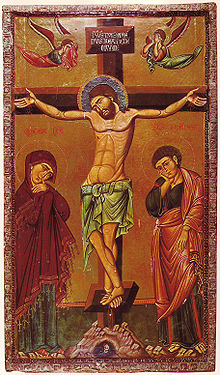
St Catherine's Monastery,c13th
Source: Wikipedia

At the beginning of this mini-series on Psalm 53 I noted that it is used intensively during the Triduum, said each day at Prime, but also at Tenebrae of Good Friday and Holy Saturday, so I thought I would conclude my notes on the psalm by coming back, briefly, to the reasons for its prominence in the older forms of the Roman Office.

The five wounds of Christ?

At first glance the five-fold appearance of the psalm during the Triduum might appear to be an accident: the psalm was, after all, said daily at Prime in the traditional version of the Roman Office and it is not altogether unusual for psalms to be said twice in a day in that form of the Office where it is appropriate to the feast or type of feast.

But if that was the case, why isn't it used at Tenebrae of Maundy Thursday, to which it is surely particularly appropriate?

My suggestion is that there is a bit of deliberate crafting here, meant to suggest the five wounds of Christ.

It is worth noting in this regard that St Hilary's commentary on the psalm notes that the psalm has a very deliberate structure, with each of the five key points of prayer matched to a result:

Petition
Result
Save me God by your name
I will give thanks unto Your name, O Lord, for it is good,
Judge me on your strength
And My eye has looked down upon Mine enemies
O God hear my prayer…
Behold God is My helper…
For strangers are risen up against Me and the violent have sought after My soul,
for You have delivered Me out of all affliction and the Lord is the upholder of My soul
they have not set God before their eyes
I will freely sacrifice to you

The Christological interpretation of the psalm

Whether or not the symbolism was deliberate, it is clear that the psalm's use during the Triduum does reflect the Christological interpretation of it suggested by St Hilary amongst others:
The suffering of the Prophet David is, according to the account we have given of the title, a type of the Passion of our God and Lord Jesus Christ. This is why his prayer also corresponds in sense with the prayer of Him Who being the Word was made flesh: in such wise that He Who suffered all things after the manner of man, in everything He said, spoke after the manner of man; and He who bore the infirmities and took on Him the sins of men approached God in prayer with the humility proper to men. 
This interpretation, even though we be unwilling and slow to receive it, is required by the meaning and force of the words, so that there can be no doubt that everything in the Psalm is uttered by David as His mouthpiece. For he says: Save me O God, by Your name. Thus prays in bodily humiliation, using the words of His own Prophet, the Only-begotten Son of God, Who at the same time was claiming again the glory which He had possessed before the ages. He asks to be saved by the Name of God whereby He was called and wherein He was begotten, in order that the Name of God which rightly belonged to His former nature and kind might avail to save Him in that body wherein He had been born.
At Prime

The Psalm use at Prime may also in part reflect this interpretation: Psalm 53 in a sense recapitulates the Triduum, with the psalm that follows, Psalm 118, taking us to the Resurrection, for its opening verse 'Beati immaculati' proclaims that the way to heaven has been reopened.

But the psalm can also be read as encouragement for the daily spiritual battle against those who reject God, in effect a summary of one of the key themes of the Benedictine version of the hour.

St Alphonsus Liguori, for example noted that:
This psalm may serve for all Christians that find themselves assailed by the temptations of the devil.  We may remark with Cardinal Bellarmine that the holy Church wishes to teach us how to arm ourselves with prayer against the tribulations and temptations that may assail us every day.
I want to conclude though with the ninth century commentator Amalarius of Metz, who suggested that:
Singing this Psalm at this point in the day is necessary for requesting divine protection through all the hours of the day against the machinations and subtleties of the devil's deceit, of which the psalmist speaks: "For strangers rise up against us who do not set God before their eyes" and also so that he may remove us from all our tribulations, and that our eye may look down upon our enemies, as David did in his time.
Coming up next

And for the last part of Lent, a quick look at the first six verses of Psalm 30, which was previously said at Compline each night in the (pre-1911) Roman Office, and concludes with the verse Christ used on the Cross, just before dying, when he said, Father, into thy hands I commend my spirit'.

Tuesday, April 9, 2019

Psalm 53 v 7 - On the downfall of our enemies

Romanesque c1220


The final verse of Psalm 53 reinforces our reasons for praising God, focusing on his his work of rescuing us.

Quóniam ex omni tribulatióne eripuísti me: et super inimícos meos despéxit óculus meus.
For you have delivered me out of all trouble: and my eye has looked down upon my enemies.


Looking at the Latin

The key vocabulary for the verse is:

omnis, e, all, each, every
tribulatio, onis, f. , trouble, distress, anguish, affliction, tribulation
eripio, ripui, reptum, ere 3  to snatch away, to rescue, deliver
super +acc=above, upon, over, in, on
despicio, spexi, spectum, ere 3 to look away from, not to look at, to slight; to despise; to look down upon

A word by word translation runs:
Quóniam (For/because) ex (from) omni (all) tribulatióne (trouble) eripuísti (you have rescued me: * et (and) super (upon) inimícos (the enemies) meos (my) despéxit (it/he has looked down upon) óculus (the eye) meus (my).

The second phrase of the verse is the hardest to convey the sense of in English.  The Knox version, ‘Who else has delivered me from all peril, and let me see the downfall of my enemies?’, is probably the best:

DR
For you have delivered me out of all trouble:
and my eye has looked down upon my enemies.
Brenton
For thou hast delivered me out of all affliction,
and mine eye has seen my desire upon mine enemies.
RSV
For thou hast delivered me from every trouble,
and my eye has looked in triumph on my enemies.
Cover
For he hath delivered me out of all my trouble;
and mine eye hath seen his desire upon mine enemies.
Knox
who else has delivered me from all peril,
and let me see the downfall of my enemies?
College
For you have snatched me from all my affliction,
and my eye looks down upon my enemies.
Grail
For you have rescued me from all distress
and my eyes have seen the downfall of my foes.


Suffering leads us to love of God

Modern commentaries often implicitly or explicitly reject the need for us to call for help in times of trouble, seeing it as altogether too mercenary.   They insist instead that love of God springs into being spontaneously and instantly.

The Fathers, however, pointed out that our sufferings and tribulations are necessary in order to lead us to God.  St Augustine for example said:
For this cause I have perceived how good a thing is Your name: for if this I were able before tribulations to acknowledge, perchance for me there had been no need of them. But tribulation has been applied for admonition, admonition has redounded to Your praise. For I should not have understood where I was, except of my weakness I had been admonished. Out of all tribulations, therefore, You have delivered me.

Similarly Theodoret of Cyr noted that:
Because you have rescued me from every tribulation, and my eye has looked down on my foes I shall offer you the sacrifice of praise, recounting your favors. This, in fact, is useful to me and pleasing to you (and to all helped by you). It is right for me to do this, freed as I have been from calamities of all kinds and contemplating the ruin of the enemies.

The defeat of our enemies

The more difficult part of this verse is the second: does it really imply we should rejoice over the downfall of our enemies?

St Hilary of Poitiers argued otherwise, applying the verse above all to Christ:
For the Only-begotten Son of God was not cut off by death. It is true that in order to take the whole of our nature upon Him He submitted to death, that is to the apparent severance of soul and body, and made His way even to the realms below, the debt which man must manifestly pay: but He rose again and abides for ever and looks down with an eye that death cannot dim upon His enemies, being exalted unto the glory of God and born once more Son of God after becoming Son of Man, as He had been Son of God when He first became Son of Man, by the glory of His resurrection. 
He looks down upon His enemies to whom He once said: Destroy this temple, and in three days I will build it up. And so, now that this temple of His body has been built again, He surveys from His throne on high those who sought after His soul, and, set far beyond the power of human death, He looks down from heaven upon those who wrought His death, He who suffered death, yet could not die, the God-Man, our Lord Jesus Christ, Who is blessed for ever and ever. Amen.

That said, there is nothing at all wrong in being glad that we have been delivered from those who seek to harm or kill us.  St Thomas Aquinas for example commented:
 And I will even praise you in regards to my enemies, because My eye hath looked down upon my enemies, because they were not able to kill me, or, Hath looked down, etc., because he disdains their happiness and prosperity; In his sight the malignant is brought to nothing.


Vulgate
Douay-Rheims
 In finem, in carminibus. Intellectus David, 2 cum venissent Ziphæi, et dixissent ad Saul : Nonne David absconditus est apud nos?
Unto the end, in verses, understanding for David. 2 When the men of Ziph had come and said to Saul: Is not David hidden with us?
1 Deus, in nómine tuo salvum me fac: * et in virtúte tua júdica me.
3 Save me, O God, by your name, and judge me in your strength.
2  Deus, exáudi oratiónem meam: * áuribus pércipe verba oris mei.
4 O God, hear my prayer: give ear to the words of my mouth.
3  Quóniam aliéni insurrexérunt advérsum me, et fortes quæsiérunt ánimam meam: * et non proposuérunt Deum ante conspéctum suum.
5 For strangers have risen up against me; and the mighty have sought after my soul: and they have not set God before their eyes.
4 Ecce enim Deus ádjuvat me: * et Dóminus suscéptor est ánimæ meæ.
6 For behold God is my helper: and the Lord is the protector of my soul.
5  Avérte mala inimícis meis: * et in veritáte tua dispérde illos.
7 Turn back the evils upon my enemies; and cut them off in your truth.
6  Voluntárie sacrificábo tibi, * et confitébor nómini tuo, Dómine: quóniam bonum est :
8 I will freely sacrifice to you, and will give praise, O God, to your name: because it is good:
7  Quóniam ex omni tribulatióne eripuísti me: * et super inimícos meos despéxit óculus meus.
9 For you have delivered me out of all trouble: and my eye has looked down upon my enemies.

And the concluding post in this series on Psalm 53 can be found here.