Monday, March 17, 2025

Psalm 147: verse 6 - Hard sayings and hardened hearts

Augsburger Wunderzeichenbuch, folio 19


Verse 6 of Psalm 147 continues the image of winter, with blizzards of hail to pound us.

 Text notes

6

V

Mittit crystállum suam sicut buccéllas: * ante fáciem frígoris ejus quis sustinébit?


 βάλλοντος κρύσταλλον ατο σε ψωμούς κατ πρόσωπον ψύχους ατο τίς ποστήσεται

Word by word:

Mittit (he sends) crystállum (ice) suam (his) sicut (like/as) buccéllas (morsels/fragments): ante (before) fáciem (the face) frígoris (of cold) ejus (his) quis (who) sustinébit (will stand)? Who will stand before the face of his cold?

The literal meaning of the first half of the verse here surely refers to hail, as fragments of ice.  But the word buccella is almost always translated as morsels here, since it normally means fragments, or a small mouthful (typically of bread).  One  translation that captures this is 'He scatters his hail like crumbs.'

Key words

crystallus, i. f. a crystal; ice, hail.

buccella, ae, f a small mouthful, a morsel, fragment.

 frigus, oris, n.  cold, frost, esp. the cold of winter.

Selected English translations

DR

He sends his crystal like morsels: who shall stand before the face of his cold?

Brenton

Casting forth his ice like morsels: who shall stand before his cold?

MD

He casteth down his ice like morsels, before his cold who can endure?

RSV

He casts forth his ice like morsels; who can stand before his cold?

Cover

He casteth forth his ice like morsels. Who is able to abide his frost?

Melting the icy heart of the hardened sinner

In the previous verse, the imagery of winter given was of snow and frost.  Now we turn to the third form water takes when frozen, crystalline ice, and are reminded that even it too, must yield in the face of God.

St Augustine interprets this passage as meaning that God's grace can cause even the most hardened sinner to melt in repentance, citing the example of St Paul:

Behold, the Apostle Paul was a crystal, hard, resisting the truth, crying out against the Gospel, hardening himself, as it were, against the sun....Since then he was crystal, he appeared clear and white, but he was hard and very cold. How was he bright and white? An Hebrew of the Hebrews; as touching the law, a Pharisee. Behold the brightness of crystal. Now hear the hardness of crystal. As touching zeal, persecuting the Church of Christ. Among the stoners of the holy martyr Stephen, was he, hard, perhaps harder than all. For he kept the raiment of all who were stoning,  so that he stoned by the hands of all... And who shall free himself, if God abandon him? Who is it that frees? The grace of God, through Jesus Christ our Lord. Are we then to despair? God forbid.

Cassiodorus adds that the fragments could also refer to the good works that sinners do once converted:

The Lord also casts them out like pieces of bread when they are converted, and He makes them perform His mighty deeds, through which the hungry people can feast on heavenly bread. Frusta (pieces) is the word we use for parts of anything; it also denotes different gifts of teaching which the Lord has quite often taken from sinners and deigned to demonstrate through His saints.

Pounding us into repentance!

An alternative interpretation, though, is that the morsels of ice here are God sending us intolerable hard hits to pummel us into repentance.   

And those piece of hail, St Jerome, suggests, are the hard sayings of Scripture:

....since we cannot take the meat of the divine word in its totality, it is broken up so that we may partake of it in small pieces. 


Psalm 147 – Lauda Jerusalem 

Vulgate

Douay-Rheims

Lauda, Jerúsalem, Dóminum: * lauda Deum tuum, Sion.

Praise the Lord, O Jerusalem: praise your God, O Sion.

2  Quóniam confortávit seras portárum tuárum: * benedíxit fíliis tuis in te.

Because he has strengthened the bolts of your gates, he has blessed your children within you

3  Qui pósuit fines tuos pacem: * et ádipe fruménti sátiat te.

Who has placed peace in your borders: and fills you with the fat of corn.

4  Qui emíttit elóquium suum terræ: * velóciter currit sermo ejus.

Who sends forth his speech to the earth: his word runs swiftly.

5  Qui dat nivem sicut lanam: * nébulam sicut cínerem spargit.

Who gives snow like wool: scatters mists like ashes.

 Mittit crystállum suam sicut buccéllas: * ante fáciem frígoris ejus quis sustinébit?

He sends his crystal like morsels: who shall stand before the face of his cold?

7  Emíttet verbum suum, et liquefáciet ea: * flabit spíritus ejus, et fluent aquæ.

He shall send out his word, and shall melt them: his wind shall blow, and the waters shall run.

8  Qui annúntiat verbum suum Jacob: * justítias, et judícia sua Israël.

Who declares his word to Jacob: his justices and his judgments to Israel

9  Non fecit táliter omni natióni: * et judícia sua non manifestávit eis.

He has not done in like manner to every nation: and his judgments he has not made manifest to them. Alleluia.

 For the next part in this series, continue on here.

Saturday, March 15, 2025

Ps 147 verse 5: We must become whiter than snow

Heinrich Vogtherr the Younger


This is, on the face of it, one of those rather obscure verses of Psalm 147, open to several different interpretations.

It becomes more understandable though, if we interpret it as part of an extended metaphor on the seasons.  The previous verses depicted the full harvest and tranquility of  summer and autumn that are the fruit of our perseverance; now we have a harsh winter, that will eventually be dispelled by God’s Word who brings the spring hope.  

Before we can reach that good though, we must first endure the hardships of winter, and do penance.

Text notes

5

V

Qui dat nivem sicut lanam: * nebulam sicut cinerem spargit.

JH

Qui dat nivem sicut lanam, pruinam sicut cinerem spargit.


το διδόντος χιόνα σε ριον μίχλην σε σποδν πάσσοντος

Here is a word by word translation:

 Qui (who) dat (gives) nivem (snow) sicut (like) lanam (wool): nébulam (mist) sicut (like) cínerem (ashes) spargit (he scatters)

Key vocabulary: 

nix, nivis, f snow.

lana, ae, f, wool.

 nebula, ae, f a fog, mist.

cinis, eris, m.  ashes. 

spargo sparsi, sparsum, ere 3, to sprinkle, strew, scatter. 

English translations:

DR

Who gives snow like wool: scatters mists like ashes.

Brenton

He gives snow like wool: he scatters the mist like ashes.

MD

He giveth snow like wool, He scattereth hoar-frost like ashes.

RSV

He gives snow like wool; he scatters hoarfrost like ashes.

Cover

He giveth snow like wool, and scattereth the hoarfrost like ashes.

Knox

Now he spreads a pall of snow, covers the earth with an ashy veil of mist

The seasons of our heart

St Cassiodorus argued that the allusions to winter in this verse and the next - snow, mist, ice and cold - should be regarded as metaphors for the things that harden us in sin:

All the things mentioned, snow, mist, crystal, cold are ills of this world which grip tight mortal hearts with the frost of sins, and cause them to remain in a rock-like stupor unless they are melted by the Lord's warmth. 

But he also suggests that the transformation from something frozen solid into soft snow signals that healing process:

So He makes snow like wool, so that what previously was frozen with bitter cold is transformed into woolly softness. This happens precisely when He has guided men's hearts when at their coldest through sins to the warmth of satisfaction. Snow describes man when he removes himself from the Lord; wool, when he has deserved to attain His healing. Mist denotes all sin, for it is always performed in cloudy darkness, but through the Lord's agency it is dispersed like ashes when its mass is dissolved by the grace of confession.

 A call to penance

St Jerome unpacks the basis for this metaphor a bit further, providing us with an elaborate chain of meanings interpretation of the verse, hanging off the words snow and wool, that interprets the verse as a call to repent and do penance, but also to the Eucharist:

The word of the Lord that runs swiftly is spread like snow, and the snow itself is like wool. Just think of the merciful kindness of the Lord. The food of the Lord is changed for us into a garment. John had said of the Lord Savior: 'Behold the lamb of God, who takes away the sin of the world'; and Isaiah: 'He shall be led like a lamb to the slaughter.' Of this lamb, therefore, and of this sheep, is the wool that is like snow. Isaiah says: 'Though your sins be like scarlet, they may become white as snow.' 'Cleanse me of sin with hyssop, that I may be purified; wash me, and I shall be whiter than snow.'...Mark: 'like ashes.' Do you want to be clean? Do penance. 'For I eat ashes like bread, and mingle my drink with tears.'

He therefore entreats: 

Take away, 0 Lord, my uncleanness; take away whatever there is of baseness. Grant Your snow, Your purity, to the minds and hearts of Christians. Unless You cleanse us with the snow of Your purity, we cannot wear Your garment. Christ is our garment. If we want to possess Christ as our garment, let us be pure as snow... 


Psalm 147 – Lauda Jerusalem 

Vulgate

Douay-Rheims

Lauda, Jerúsalem, Dóminum: * lauda Deum tuum, Sion.

Praise the Lord, O Jerusalem: praise your God, O Sion.

2  Quóniam confortávit seras portárum tuárum: * benedíxit fíliis tuis in te.

Because he has strengthened the bolts of your gates, he has blessed your children within you

3  Qui pósuit fines tuos pacem: * et ádipe fruménti sátiat te.

Who has placed peace in your borders: and fills you with the fat of corn.

4  Qui emíttit elóquium suum terræ: * velóciter currit sermo ejus.

Who sends forth his speech to the earth: his word runs swiftly.

5  Qui dat nivem sicut lanam: * nébulam sicut cínerem spargit.

Who gives snow like wool: scatters mists like ashes.

6  Mittit crystállum suam sicut buccéllas: * ante fáciem frígoris ejus quis sustinébit?

He sends his crystal like morsels: who shall stand before the face of his cold?

7  Emíttet verbum suum, et liquefáciet ea: * flabit spíritus ejus, et fluent aquæ.

He shall send out his word, and shall melt them: his wind shall blow, and the waters shall run.

8  Qui annúntiat verbum suum Jacob: * justítias, et judícia sua Israël.

Who declares his word to Jacob: his justices and his judgments to Israel

9  Non fecit táliter omni natióni: * et judícia sua non manifestávit eis.

He has not done in like manner to every nation: and his judgments he has not made manifest to them. Alleluia.

And for the next post in this series, continue on here.

Friday, March 14, 2025

Psalm 147, verse 4: He sends out his Word


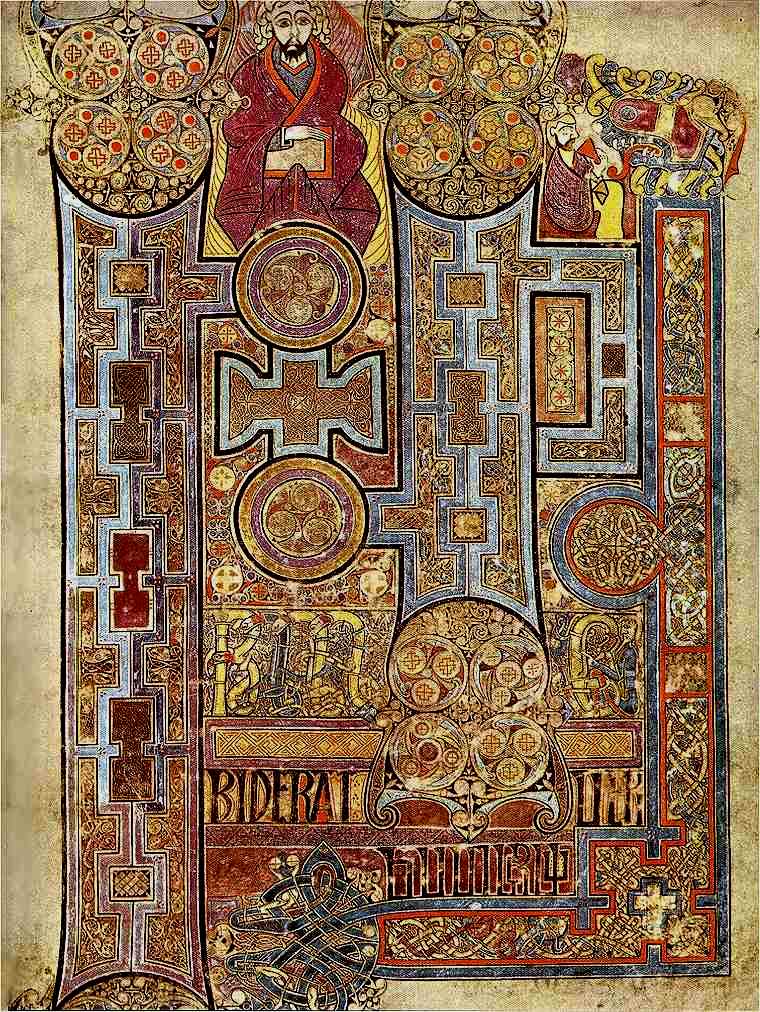
Book of Kells, Folio 292r


Today's verse of Psalm 147 can be seen as a prophesy of God's sending of his son to earth so that the Gospel might be preached everywhere.

Text notes 

4

V

Qui emittit eloquium suum terræ: * velociter currit sermo ejus.

JH

Qui emittit eloquium suum terrae, velociter currit verbum eius.


 ποστέλλων τ λόγιον ατο τ γ ως τάχους δραμεται  λόγος ατο

Word by word:

 Qui (who) emíttit (sends) elóquium (word) suum (his) terræ (to the earth): velóciter (quickly) currit (it runs) sermo (command) ejus (his) = his command runs quickly

Key vocabulary

eloquium, ii, n.a word, oracle, speech, utterance, promise. 

sermo, onis, m. words; a command, edict word, speech, saying, discourse scheme, plan, proposal

emitto, misi, missum, ere 3 to send out or forth; to stretch forth, put forth

velociter, adv. (velox),swiftly, quickly, speedily, rapidly

curro, cucurri, cursum, ere 3, to run, hasten.  

DR

Who sends forth his speech to the earth: his word runs swiftly.

Brent.

He sends his oracle to the earth: his word will run swiftly.

MD

He sendeth forth His word to the earth and swiftly runneth His command

RSV

He sends forth his command to the earth; his word runs swiftly.

Cover

He sendeth forth his commandment upon earth, and his word runneth very swiftly.

Knox

See how he issues his command to the earth, how swift his word runs!


Make disciples of all nations


The first few verses speak of the Church: first his chosen people, the Jews, and then, when they rejected him, those brought into his church under the new covenant.  


This verse, however, points out that God's plan does not stop there: the aim is the conversion of the whole world. 


 God as the creator and sustainer of all

The swiftness with which God's word in this verse is often interpreted as referring to the rapid spread of the Gospel to all the corners of the earth, as Cassiodorus pointed out:

The speech of this almighty Word has run so swiftly that the speediest acknowledg­ment of the holy Trinity has filled the world with wondrous haste, transforming cults of idols through the manifestation of Truth itself.

But can also be taken as referring to God's creation and ongoing governance of the world, as St Robert Bellarmine explains:

He, there­fore, exhorts them to praise that God, "who sendeth forth his speech to the earth," who issues the precepts and decrees of his providence to the whole world; and "his word runneth quick­ly;" such precepts and decrees are borne with the greatest expe­dition to all created beings, penetrate all things, and are put into immediate execution. These words explain the order of divine providence that extends itself to everything, and that with the greatest velocity because God is everywhere, "upholding all things by the word of his power," (Heb. 1); and "reaches from end to end mightily, and ordereth all things sweetly," (Wisd. 8). Hence, David says, in Psalm 118, "All things serve thee."

Pope John Paul II put it this way:


The Lord, therefore, acts with his Word not only in creation but also in history. He reveals himself with the silent language of nature (cf. Ps 19[18]: 2-7), but expresses himself in an explicit way through the Bible and his personal communication through the prophets and fully through the Son (cf. Heb 1: 1, 2). They are two different but converging gifts of His love. For this reason, our praise must rise to heaven each day...to bless the Lord of life and freedom, of existence and faith, of creation and redemption. 


Psalm 147 – Lauda Jerusalem 

Vulgate

Douay-Rheims

Lauda, Jerúsalem, Dóminum: * lauda Deum tuum, Sion.

Praise the Lord, O Jerusalem: praise your God, O Sion.

2  Quóniam confortávit seras portárum tuárum: * benedíxit fíliis tuis in te.

Because he has strengthened the bolts of your gates, he has blessed your children within you

3 Qui pósuit fines tuos pacem: * et ádipe fruménti sátiat te.

Who has placed peace in your borders: and fills you with the fat of corn.

Qui emíttit elóquium suum terræ: * velóciter currit sermo ejus.

Who sends forth his speech to the earth: his word runs swiftly.

5 Qui dat nivem sicut lanam: * nébulam sicut cínerem spargit.

Who gives snow like wool: scatters mists like ashes.

6  Mittit crystállum suam sicut buccéllas: * ante fáciem frígoris ejus quis sustinébit?

He sends his crystal like morsels: who shall stand before the face of his cold?

7  Emíttet verbum suum, et liquefáciet ea: * flabit spíritus ejus, et fluent aquæ.

He shall send out his word, and shall melt them: his wind shall blow, and the waters shall run.

8 Qui annúntiat verbum suum Jacob: * justítias, et judícia sua Israël.

Who declares his word to Jacob: his justices and his judgments to Israel

9 Non fecit táliter omni natióni: * et judícia sua non manifestávit eis.

He has not done in like manner to every nation: and his judgments he has not made manifest to them. Alleluia.

And for the next post in this series, continue on here.

Thursday, March 13, 2025

Psalm 147 v3: The bread of heaven

Pieter Bruegel the Elder


Verse 3 of Psalm 147 continues the list of reasons why we should praise God, adding the gift of peace and prosperity to verse 2's thanks for strengthening the gates and blessing those protected within them.

There is, in this verse, a lot of imagery redolent of the late days of summer, when the harvest is in, and all is calm and well, and that is important, for later verses in the psalm tell us that to get there, we have to endure the hardships of winter first.

Looking at the Latin

3

V

Qui posuit fines tuos pacem: * et adipe frumenti satiat te.

JH

Qui ponit fines tuos pacem et adipe frumenti satiat te.


  τιθες τ ριά σου ερήνην κα στέαρ πυρο μπιπλν σε

Word by word

 Qui (who) pósuit (sets/places) fines (the borders/boundaries/limits) tuos (your) pacem (peace): et (and) ádipe (with the fat) fruménti (of wheat/grains) sátiat (he satisfies/fills) te (you).

Notes

Frumentum is a generic word for corn or grains of any kind, hence the variety of English translations for it.

The word adipe comes from adeps, and normally means fat or marrow, but in this context seems best translated as 'full ears of wheat' (as Knox does), or the best, finest, or choicest of grains.

Key vocab

pono, posui, itum, ere 3,  to put, place, lay, set.

finis, is, m., a boundary, limit, border; territory.  usque in finem =  utterly, altogether; or, always, forever

adeps, ipis, c. fat, marrow;

satio, avi, atum, are, to fill, sate, satisfy

frumentum, i, n.  corn, i.e., wheat, rye, barley, etc.

DR

Who has placed peace in your borders: and fills you with the fat of corn.

Brenton

He makes thy borders peaceful, and fills thee with the flour of wheat.

MD

He hath made peace in thy borders, He hath filled thee with the fat of wheat

RSV

He makes peace in your borders; he fills you with the finest of the wheat.

Cover

He maketh peace in thy borders, and filleth thee with the flour of wheat.

Knox

That makes thy land a land of peace, and gives thee full ears of wheat to sustain thee.

The promises of heaven

This verse can be interpreted on two levels: first, as describing the nature of the heavenly Jerusalem that is promised to those who persevere to the end; and secondly in terms of the here and now.

St Robert Bellarmine argues that the promise of peace and prosperity set out in this verse ultimately only applies in full to heaven:

All this applies to our heavenly country in the strict sense of the words, for there alone will our inferior be in strict peace with our superior parts, and our superior parts with God; and there, too, will be strict peace between the citizens of all grades, high and low; for there will be one heart, one soul, and as the Lord expresses it, "Made perfect in one." 

In heaven, he suggests, we will be filled with the best of corn, that is, truth and wisdom as the food of the soul: 

There, too, "will all be filled with the fat of com," for truth and wisdom being the food of the soul, they will have actual truth as it is in itself, and not in fig­ures or enigmas, and they will taste of the sweetness of the Word Eternal without being enveloped by the sacraments or the Scriptures; they will drink of the fountain of wisdom, instead of applying to the streams that flow from it, or to the "showers falling gently upon the earth." They will be so filled that they will never again hunger nor thirst for all eternity. 

Prosperity and the bread of life

But these promises are also fulfilled in shadow form in the Church militant, he argues.

He points out that virtually all of the Fathers argue that the best of wheat should be interpreted spiritually as meaning both Christ and the Eucharist.

St Jerome explained the symbolism of wheat as meaning Christ by reference to John 12:24:

'Unless the grain of wheat fall into the ground and die, it remains alone, but if it die it brings about the salvation of many.'  Our Lord, the grain of wheat, has fallen into the ground and has multiplied us. This grain of wheat is very fertile, full of marrow, rich, fruitful. 'With the best of wheat he fills you.' Happy the man who perceives the richness of this grain. 

But it also, he argues, refers to both the Eucharist and the Gospel:

We have read the Sacred Scriptures. I think the Gospel is the body of Christ; Holy Writ, His teaching. When He says: 'He who does not eat my flesh and drink my blood,' although the words may be understood in their mystical sense, nevertheless, I say the word of Scripture is truly the body of Christ and His blood; it is divine doctrine. 

It follows that we must treat both with reverence: 

If at any time we approach the Sacrament - the faithful understand what I mean - and a tiny crumb should fall, we are appalled. Even so, if at any time we hear the word of God, through which the body and blood of Christ is being poured into our ears, and we yield carelessly to distraction, how responsible are we not for our failing? 

Seek after peace and pursue it

Indeed, it is these two gifts, the Eucharist and the Gospel, gifts that enable us to contemplate the Godhead, that are the path to achieving that most Benedictine of virtues, peace, as St Cassiodorus explained:

Next comes the explanation of how this peace emerges, when the faithful are filled with contemplation of the Lord Christ, for the fat of corn denotes the vision of the Godhead, by which the thoughts of the just are refreshed in such a way as clearly to transcend all possible satiety, since He is the true Bread which came down from heaven. 

There is a paradox involved here though, for achieving peace in this life involves a struggle: we must wage war with the world in order to achieve peace.

This is challenging: in the face of anger, in the face of those who hate peace, we have to strive to make the conflict theirs, not ours.


Vivladi

Psalm 147 – Lauda Jerusalem 

Vulgate

Douay-Rheims

Lauda, Jerúsalem, Dóminum: * lauda Deum tuum, Sion.

Praise the Lord, O Jerusalem: praise your God, O Sion.

2  Quóniam confortávit seras portárum tuárum: * benedíxit fíliis tuis in te.

Because he has strengthened the bolts of your gates, he has blessed your children within you

3  Qui pósuit fines tuos pacem: * et ádipe fruménti sátiat te.

Who has placed peace in your borders: and fills you with the fat of corn.

4  Qui emíttit elóquium suum terræ: * velóciter currit sermo ejus.

Who sends forth his speech to the earth: his word runs swiftly.

5  Qui dat nivem sicut lanam: * nébulam sicut cínerem spargit.

Who gives snow like wool: scatters mists like ashes.

6  Mittit crystállum suam sicut buccéllas: * ante fáciem frígoris ejus quis sustinébit?

He sends his crystal like morsels: who shall stand before the face of his cold?

7  Emíttet verbum suum, et liquefáciet ea: * flabit spíritus ejus, et fluent aquæ.

He shall send out his word, and shall melt them: his wind shall blow, and the waters shall run.

8  Qui annúntiat verbum suum Jacob: * justítias, et judícia sua Israël.

Who declares his word to Jacob: his justices and his judgments to Israel

9  Non fecit táliter omni natióni: * et judícia sua non manifestávit eis.

He has not done in like manner to every nation: and his judgments he has not made manifest to them. Alleluia.

And for the next part in this series, continue on here.